Eid, Diwali, Lunar New Year and Hanukkah dates
Holidays that follow the moon move against our calendar every year. Here they are to 2035 — Islamic, Hindu, Chinese and Jewish — with an honest word on where a date can be a day off.
Diwali 2026:
Hanukkah 2026: first candle on the evening of
Lunar New Year 2027:
Eid al-Fitr 2027: , give or take a day
Holi 2027:
Eid al-Adha 2027: , give or take a day
Eid al-Fitr and Eid al-Adha
| Year | Eid al-Fitr1 Shawwal | Eid al-Adha10 Dhu al-Hijjah |
|---|---|---|
| 2026 | ||
| 2027 | ||
| 2028 | ||
| 2029 | ||
| 2030 | ||
| 2031 | ||
| 2032 | ||
| 2033 | and | |
| 2034 | ||
| 2035 |
Eid al-Fitr (Eid ul-Fitr) ends Ramadan; Eid al-Adha (Eid ul-Adha, or Bakrid) comes about ten weeks later. The Islamic calendar is lunar and its year is about eleven days shorter than ours, so both Eids come roughly eleven days earlier each year — which is why Eid al-Fitr falls twice in 2033.
The dates above follow the Umm al-Qura calendar, Saudi Arabia's official one. In many countries the day is set by sighting the new moon and announced only the evening before, so where you are, Eid can fall a day later or a day earlier. Published tables reach only a few years ahead; the later dates here are calculated, and tables can disagree by a day. Treat every Eid date on this page as ±1 day.
Diwali and Holi
| Year | DiwaliLakshmi Puja | Holithe day of colours |
|---|---|---|
| 2026 | ||
| 2027 | ||
| 2028 | ||
| 2029 | ||
| 2030 | ||
| 2031 | ||
| 2032 | ||
| 2033 | ||
| 2034 | ||
| 2035 |
Diwali — the night of Lakshmi Puja — falls on the new moon of Kartika in the North Indian calendar, so in October or November; Holi, the festival of colours, comes the day after the Phalguna full moon, in March. Both follow the Hindu lunisolar calendar, and regional calendars can put them a day apart.
The dates here are for New Delhi, taken from published tables and checked against an independent astronomical calculation.
Lunar New Year
| Year | Lunar New Year1st day of the 1st month |
|---|---|
| 2026 | |
| 2027 | |
| 2028 | |
| 2029 | |
| 2030 | |
| 2031 | |
| 2032 | |
| 2033 | |
| 2034 | |
| 2035 |
Lunar New Year — Chinese New Year, or the Spring Festival in China — is the first day of the first month of the Chinese calendar, and always falls between 21 January and 20 February.
Passover, Rosh Hashanah and Hanukkah
| Year | Passover15 Nisan | Rosh Hashanah1 Tishrei | Hanukkah25 Kislev |
|---|---|---|---|
| 2026 | from sundown | from sundown | from sundown |
| 2027 | from sundown | from sundown | from sundown |
| 2028 | from sundown | from sundown | from sundown |
| 2029 | from sundown | from sundown | from sundown |
| 2030 | from sundown | from sundown | from sundown |
| 2031 | from sundown | from sundown | from sundown |
| 2032 | from sundown | from sundown | from sundown |
| 2033 | from sundown | from sundown | from sundown |
| 2034 | from sundown | from sundown | from sundown |
| 2035 | from sundown | from sundown | from sundown |
A Jewish holiday begins at sundown the evening before its first full day. The table gives both: the first full day — Pesach (Passover) on 15 Nisan, Rosh Hashanah, the Jewish New Year, on 1 Tishrei, Hanukkah (Chanukah) on 25 Kislev — and the evening it starts. Hanukkah lasts eight nights; the first candle is lit on that first evening.
About Giftwise
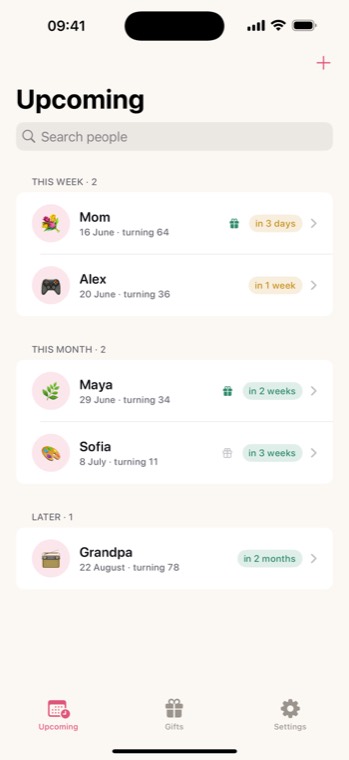
This page belongs to Giftwise, an iPhone app for birthday reminders and gift ideas. It keeps each person's birthday, reminds you a week ahead, the day before and on the day, and holds gift ideas and a wishlist for that person.
None of the holidays on this page is among the ones Giftwise offers, and a date you add yourself (a Pro feature) stays on the same day of the month every year — so for a holiday that follows the moon, look the date up here.
More dates
Last reviewed 12 October 2026