100 envelope challenge: how it works, what it adds up to and a printable tracker
Number 100 envelopes from 1 to 100. Each time you draw one, you set aside as many dollars as its number. When all 100 are used, you have $5,050. On this page: the arithmetic, other versions, how long each takes, and a 10 × 10 tracker to print in order or shuffled.
The envelopes hold 1, 2, 3 … 100 times your smallest amount, so they add up to 5,050 times it. With $1 as the smallest amount that is $5,050; with 50 cents it is $2,525; with $2 it is $10,100.
Print a 10 × 10 tracker
100-envelope challenge
Envelope 1 holds $1, envelope 2 holds $2 … envelope 100 holds $100. Total $5,050.
In order, 1 to 100. Open them in any order you like and cross each one off as you set that amount aside.
- 1
- 2
- 3
- 4
- 5
- 6
- 7
- 8
- 9
- 10
- 11
- 12
- 13
- 14
- 15
- 16
- 17
- 18
- 19
- 20
- 21
- 22
- 23
- 24
- 25
- 26
- 27
- 28
- 29
- 30
- 31
- 32
- 33
- 34
- 35
- 36
- 37
- 38
- 39
- 40
- 41
- 42
- 43
- 44
- 45
- 46
- 47
- 48
- 49
- 50
- 51
- 52
- 53
- 54
- 55
- 56
- 57
- 58
- 59
- 60
- 61
- 62
- 63
- 64
- 65
- 66
- 67
- 68
- 69
- 70
- 71
- 72
- 73
- 74
- 75
- 76
- 77
- 78
- 79
- 80
- 81
- 82
- 83
- 84
- 85
- 86
- 87
- 88
- 89
- 90
- 91
- 92
- 93
- 94
- 95
- 96
- 97
- 98
- 99
- 100
iliafiliaev.com/pennyweek/100-envelope-challenge/
Download the tracker as a PDF
One US Letter page with the numbers 1 to 100 in a 10 × 10 grid, for $1 as the smallest envelope — each square is also its amount in dollars. On A4 paper choose “fit” or “scale to fit” in the print dialog, or print this page, which uses your printer's own paper size and can also shuffle the squares.
How the 100 envelope challenge works
- Number 100 envelopes from 1 to 100 — or use a tracker like the one above and skip the envelopes.
- Each number is an amount. Envelope 7 is $7, envelope 92 is $92. With a different smallest amount, multiply: with 50 cents as the smallest, envelope 92 is $46.
- Draw an envelope — at random, or in order — set that amount aside, and cross its number off.
- Repeat until all 100 are used. Together they add up to $5,050 with $1 as the smallest amount.
A shuffled tracker does the drawing for you: the next square along the row is your next envelope.
Do I need real envelopes?
No. The envelopes are packaging; the challenge is a list of 100 amounts, 1 to 100 times your smallest, each used once and in any order. Paper envelopes, a numbered grid or an app all work — what counts is that you actually set the money aside when you cross a number off. In Pennyjar there is nothing to buy or cut out: you get 100 envelopes, open them in any order, and mark each one as you set its amount aside.
How much it adds up to
1 + 2 + … + 100 is 5,050, which is 100 × 101 ÷ 2. Multiply by your smallest amount for the total, in any currency. The average envelope holds $50.50 when the smallest is $1.
| Smallest envelope | Largest envelope | All 100 add up to |
|---|---|---|
| $0.50 | $50 | $2,525 |
| $1 | $100 | $5,050 |
| $2 | $200 | $10,100 |
| $5 | $500 | $25,250 |
| $10 | $1,000 | $50,500 |
Some people run a shorter version with fewer envelopes. The total for n envelopes is n × (n + 1) ÷ 2 times the smallest amount. Pennyjar runs the 100-envelope version; the others are for paper.
| Version | Largest envelope | All of them add up to |
|---|---|---|
| 25 envelopes | $25 | $325 |
| 50 envelopes | $50 | $1,275 |
| 75 envelopes | $75 | $2,850 |
| 100 envelopes | $100 | $5,050 |
To end with $1,000, $5,000 or $10,000
Divide the target by 5,050 and round up to the next cent to get the smallest envelope. Rounding up means the 100 envelopes never add up to less than the target; the last column shows what they really add up to.
| To end with | Smallest envelope | Largest envelope | Adds up to |
|---|---|---|---|
| $1,000 | $0.20 | $20 | $1,010 |
| $2,500 | $0.50 | $50 | $2,525 |
| $5,000 | $1 | $100 | $5,050 |
| $10,000 | $1.99 | $199 | $10,049.50 |
| $20,000 | $3.97 | $397 | $20,048.50 |
How long does it take?
The challenge has no calendar, so you can open an envelope whenever you like. At a steady pace, 100 envelopes take this long. Two a week is 50 weeks, a year with two weeks to spare; three a week is 34 weeks, because the 34th week has only one envelope left.
| Pace | All 100 are open after |
|---|---|
| 1 envelope a day | 100 days |
| 1 envelope a week | 100 weeks |
| 2 envelopes a week | 50 weeks |
| 3 envelopes a week | 34 weeks the last week has 1 envelope |
| 5 envelopes a week | 20 weeks |
| 10 envelopes a week | 10 weeks |
| 1 envelope per paycheck, paid every two weeks | 100 paychecks 200 weeks |
| 2 envelopes per paycheck, paid every two weeks | 50 paychecks 100 weeks |
| 4 envelopes per paycheck, paid every two weeks | 25 paychecks 50 weeks |
| 10 envelopes a month | 10 months |
The 100 envelopes in Pennyjar
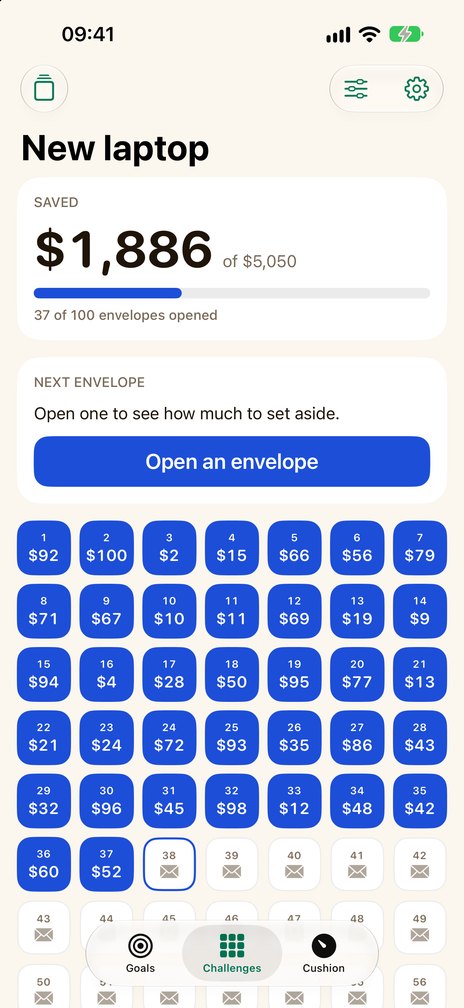
The 100-envelope challenge is one of the two challenges on the Challenges tab of Pennyjar, an iPhone and iPad app with Goals, Challenges and Cushion tabs. You get 100 envelopes that hold 1 to 100 times your smallest amount, opened in any order. With $1 as the smallest they add up to $5,050.
A weekly reminder, on the day and at the time you choose, is optional. Free Pennyjar runs one challenge at a time; Pennyjar Pro, one payment for the whole app, lets several run together and adds custom challenges of 2 to 156 weeks with your own amounts. Pennyjar is a record of what you set aside: it never holds or moves your money, and it is not financial advice.
Coming soon to the App Store
More savings charts
More free savings tools
Last reviewed 8 October 2026