Printable 52-week money challenge
Choose a starting amount and an order, set the date of week 1, and get a 52-week chart that prints on one page. Below it: what the challenge adds up to, how to reach a target, the reverse version and what to do when you miss a week. Everything is worked out in your browser.
Set aside $1 in week 1, $2 in week 2, and so on up to $52 in week 52, and the year adds up to $1,378. The total is always 1,378 times the starting amount: start with $2 — the “double” version — and it is $2,756; start with $5 and it is $6,890.
Make your chart
52-week money challenge
A little more each week: $1 in week 1, $2 in week 2 … $52 in week 52. Total $1,378.
Week 1: Monday, January 4, 2027 · Week 52: Monday, December 27, 2027 · every Monday
| Week | Date | Deposit | Total | Done |
|---|---|---|---|---|
| 1 | $1 | $1 | ||
| 2 | $2 | $3 | ||
| 3 | $3 | $6 | ||
| 4 | $4 | $10 | ||
| 5 | $5 | $15 | ||
| 6 | $6 | $21 | ||
| 7 | $7 | $28 | ||
| 8 | $8 | $36 | ||
| 9 | $9 | $45 | ||
| 10 | $10 | $55 | ||
| 11 | $11 | $66 | ||
| 12 | $12 | $78 | ||
| 13 | $13 | $91 | ||
| 14 | $14 | $105 | ||
| 15 | $15 | $120 | ||
| 16 | $16 | $136 | ||
| 17 | $17 | $153 | ||
| 18 | $18 | $171 | ||
| 19 | $19 | $190 | ||
| 20 | $20 | $210 | ||
| 21 | $21 | $231 | ||
| 22 | $22 | $253 | ||
| 23 | $23 | $276 | ||
| 24 | $24 | $300 | ||
| 25 | $25 | $325 | ||
| 26 | $26 | $351 |
| Week | Date | Deposit | Total | Done |
|---|---|---|---|---|
| 27 | $27 | $378 | ||
| 28 | $28 | $406 | ||
| 29 | $29 | $435 | ||
| 30 | $30 | $465 | ||
| 31 | $31 | $496 | ||
| 32 | $32 | $528 | ||
| 33 | $33 | $561 | ||
| 34 | $34 | $595 | ||
| 35 | $35 | $630 | ||
| 36 | $36 | $666 | ||
| 37 | $37 | $703 | ||
| 38 | $38 | $741 | ||
| 39 | $39 | $780 | ||
| 40 | $40 | $820 | ||
| 41 | $41 | $861 | ||
| 42 | $42 | $903 | ||
| 43 | $43 | $946 | ||
| 44 | $44 | $990 | ||
| 45 | $45 | $1,035 | ||
| 46 | $46 | $1,081 | ||
| 47 | $47 | $1,128 | ||
| 48 | $48 | $1,176 | ||
| 49 | $49 | $1,225 | ||
| 50 | $50 | $1,275 | ||
| 51 | $51 | $1,326 | ||
| 52 | $52 | $1,378 |
iliafiliaev.com/pennyweek/52-week-money-challenge/
Download a PDF
Three one-page charts with a real empty square to tick for every week and a blank column to write the date you saved. They are US Letter; on A4 paper choose “fit” or “scale to fit” in the print dialog — or use the Print button above, which prints on whatever paper your printer is set to and also fills in the dates.
How much do I need to start with to reach a target?
A little more each week: start with $3.63. Week 52 is $188.76 and the year adds up to $5,002.14.
The same every week: set aside $96.16 a week. The year adds up to $5,000.32.
Rounded up to the next cent, so the year never falls short of the target; the total shown is what the amount really adds up to. The currency sign is the one in the form above.
What the 52-week money challenge is
It is a year of weekly deposits that grow by the same step. Week 1 is the starting amount, week 2 is twice that, week 3 three times, and week 52 is 52 times the starting amount. With a $1 start you set aside $1 in week 1, $2 in week 2, and $52 in week 52. A chart lists every amount, so all you have to do each week is look up this week's number, move that money into your savings and tick the box.
How it works
- Pick a starting amount you can still afford in the last week. Week 52 is 52 times the starting amount: $260 if you start with $5.
- Choose the order — classic, reverse or the same every week — and the date of week 1.
- Print the chart or save it as a PDF.
- Each week, set aside that week's amount wherever you keep your savings, and tick its box.
- In week 52 the running total on the last row is what you have saved.
How much you save
Adding 1 + 2 + … + 52 gives 1,378 — that is 52 × 53 ÷ 2. Multiply it by your starting amount to get the total, whatever the currency. The average week is 26.5 times the starting amount, which is $26.50 on a $1 start.
| Starting amount | Week 1 | Week 52 | The year adds up to |
|---|---|---|---|
| $1 | $1 | $52 | $1,378 |
| $2 the “double” version | $2 | $104 | $2,756 |
| $3 | $3 | $156 | $4,134 |
| $5 | $5 | $260 | $6,890 |
| $10 | $10 | $520 | $13,780 |
| $20 | $20 | $1,040 | $27,560 |
Starting amounts do not have to be whole numbers: 50 cents gives $689 and 50p gives £689.
To end the year with $1,000, $5,000 or $10,000
Divide the target by 1,378 for the classic order, or by 52 for the same amount every week, and round up to the next cent. The tables below do that and show what each rounded amount really adds up to. If you prefer a round starting amount, $3 adds up to $4,134 and $4 to $5,512.
| To end the year with | Start with | Adds up to |
|---|---|---|
| $1,000 | $0.73 | $1,005.94 |
| $2,500 | $1.82 | $2,507.96 |
| $5,000 | $3.63 | $5,002.14 |
| $10,000 | $7.26 | $10,004.28 |
| To end the year with | Save every week | Adds up to |
|---|---|---|
| $1,000 | $19.24 | $1,000.48 |
| $2,500 | $48.08 | $2,500.16 |
| $5,000 | $96.16 | $5,000.32 |
| $10,000 | $192.31 | $10,000.12 |
The reverse version, and why people choose it
Reverse means largest first: week 1 is 52 times the starting amount and week 52 is the starting amount. The total does not change — $1,378 for a $1 start — only the order does.
Its appeal is two things. The big deposits come at the start, while motivation is high and nothing has gone wrong yet; and if you begin in January, the small ones land in the last weeks of the year, when holiday spending is often highest. The catch is week 1: with a $5 start it is $260. If that is more than you can set aside at once, use the classic order or a smaller starting amount.
The third order, the same amount every week, makes 52 equal deposits: $10 a week is $520. It is the easiest to budget for.
Starting in the middle of the year
Week 1 is whichever date you choose, and each later week falls exactly 7 days after the one before. Week 52 is therefore 357 days after week 1, a little under a year: a challenge that starts on Monday, January 4, 2027 ends on Monday, December 27, 2027. To finish on a fixed day, count back 357 days from it and begin there. If you have already saved some weeks, tick them and carry on from the next one.
What to do about a missed week
The chart is a list of amounts, not a deadline, so a missed week can be paid later and ticked then. Decide the rule before you need it. Either pay missed weeks back as soon as you can, and the total at the end is unchanged; or let them go and accept a smaller one — skipping week 10 of the $1 classic chart costs $10 of the $1,378.
The 52-week challenge in Pennyjar
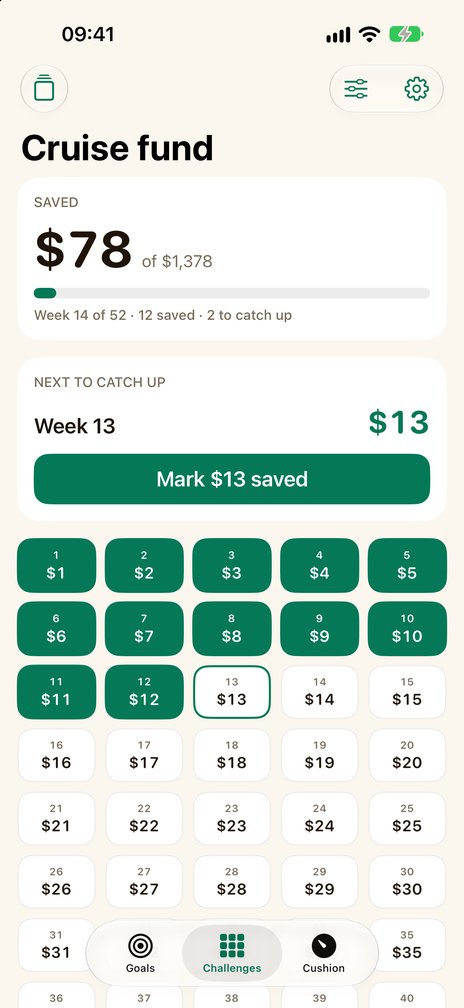
Pennyjar is an iPhone and iPad app with three tabs: Goals, Challenges and Cushion. The Challenges tab keeps this challenge for you: start at $1 and week 52 is $52, $1,378 in all; or start with the largest amount, or save the same amount every week. Tap a week to mark it saved; the app shows which week you are in and how many you have to catch up on. An optional weekly reminder arrives on the day and at the time you choose, if notifications are allowed.
If you started on paper, say how many weeks are already saved and the app marks them for you. Pennyjar is a record of what you set aside: it never holds or moves your money, and it is not financial advice.
Coming soon to the App Store
More savings charts
- Money saving challenge printablesevery PDF side by side, and which one fits
- 100 envelope challengehow it works, $5,050 in total, a printable tracker
- Biweekly savings challengecharts for 26 paychecks
- Monthly savings challengetwelve deposits, for any target
- Penny challenge (1p a day)365 days, month by month
More free savings tools
Last reviewed 8 October 2026