Money saving challenge printables: free PDF charts for weekly, biweekly and monthly pay
One-page PDFs to print: the 52-week challenge, 100 envelopes, a monthly chart, two biweekly charts and the penny challenge in a US and a UK version, plus blank charts for your own amounts. Below them: what each one adds up to, side by side, and which one fits how you are paid.
A money saving challenge is a list of amounts to set aside, one for each step, with a box to tick when you have done it. The steps can be weeks, paydays, months or days: the printables here have 12, 26, 52, 100 or 365 of them. At the amount each PDF is made for, the 52-week challenge adds up to $1,378, the monthly chart to $1,950, the penny challenge to $667.95 and 100 envelopes to $5,050. Choose by how often you are paid.
Pick a free money saving challenge PDF
Every PDF is one page with a square for each step to tick or cross off. They are US Letter, except the UK penny chart, which is A4; on other paper choose “fit” or “scale to fit” in the print dialog. They are free to download, and each one has a page with a calculator for a version of your own.
Paid every week
-
52-week challenge, classic
$1 in week 1, $2 in week 2 … $52 in week 52. Runs 52 weeks; adds up to $1,378 with a $1 start.
Download the PDF: 52-week challenge, classic Calculator for the 52-week challenge
-
52-week challenge, reverse
The same weeks backwards, so the big deposits come first: $52 in week 1 down to $1 in week 52. Runs 52 weeks; adds up to $1,378 with a $1 start.
Download the PDF: 52-week challenge, reverse Calculator for the 52-week challenge
-
52-week challenge, blank chart
52 weeks with the amounts left empty, for a plan of your own. Runs 52 weeks; the total is whatever you write in.
Download the PDF: 52-week challenge, blank chart Calculator for the 52-week challenge
At any pace: envelopes
-
100-envelope challenge tracker
The numbers 1 to 100 to cross off, each worth that many dollars, in any order. Runs until all 100 are used; adds up to $5,050 with $1 as the smallest.
Download the PDF: 100-envelope challenge tracker Calculator for the 100-envelope challenge
Paid every two weeks
-
Biweekly: the 52-week challenge in 26 deposits
Two weeks of the 52-week challenge at each paycheck: $3, $7, $11 … $103. Runs 26 paychecks; adds up to $1,378 with a $1 start.
Download the PDF: biweekly, the 52-week challenge in 26 deposits Calculator for the biweekly challenge
-
Biweekly: 26 steps
One dollar more at each paycheck: $1, $2 … $26. Runs 26 paychecks; adds up to $351.
Download the PDF: biweekly, 26 steps Calculator for the biweekly challenge
-
Biweekly: blank chart
26 paychecks with the amounts left empty. Runs 26 paychecks; the total is whatever you write in.
Download the PDF: biweekly, blank chart Calculator for the biweekly challenge
Paid once a month
-
Monthly: $25 more each month
$25 in month 1, $50 in month 2 … $300 in month 12. Runs 12 months; adds up to $1,950.
Download the PDF: monthly, $25 more each month Calculator for the monthly challenge
-
Monthly: blank chart
12 months with the amounts left empty. Runs 12 months; the total is whatever you write in.
Download the PDF: monthly, blank chart Calculator for the monthly challenge
Something every day: the penny challenge
-
Penny challenge, US
1¢ on day 1, 2¢ on day 2 … $3.65 on day 365, in cents and dollars. Runs 365 days; adds up to $667.95. US Letter.
Download the PDF: penny challenge, US Calculator for the penny challenge
-
Penny challenge, UK
1p on day 1, 2p on day 2 … £3.65 on day 365, in pence and pounds. Runs 365 days; adds up to £667.95. A4.
Download the PDF: penny challenge, UK Calculator for the penny challenge
Money saving challenges compared
The numbers are for the amount each PDF is made for. A bigger starting amount makes every deposit, and the total, bigger in the same proportion: the 52-week challenge starting at $2 adds up to $2,756, twice the $1,378 of a $1 start. The two penny rows are one challenge in two currencies. The blank charts have no amounts, so they are not in the table.
| Challenge | Steps | First amount | Last amount | Total |
|---|---|---|---|---|
| Monthly$25 more each month | 12months | $25 | $300 | $1,950 |
| Biweekly, 26 steps$1 more at each paycheck | 26paychecks | $1 | $26 | $351 |
| Biweekly, 52 weeks in 26 depositsthe 52-week challenge, $1 start | 26paychecks | $3 | $103 | $1,378 |
| 52-week challengeclassic order, $1 start | 52weeks | $1 | $52 | $1,378 |
| 52-week challenge, reverselargest first, $1 start | 52weeks | $52 | $1 | $1,378 |
| 100 envelopes$1 as the smallest | 100envelopes | $1 | $100 | $5,050 |
| Penny challenge, USa cent more every day | 365days | $0.01 | $3.65 | $667.95 |
| Penny challenge, UK1p more every day | 365days | £0.01 | £3.65 | £667.95 |
Which money saving challenge fits
Match the challenge to the day the money arrives, so that setting an amount aside is a tick on payday and not a separate chore.
- Paid every week. The 52-week challenge has one deposit a week, $1 rising to $52; the reverse chart starts with the $52 and ends with $1. Either way it adds up to $1,378 with a $1 start.
- Paid every two weeks. A weekly challenge does not follow a paycheck every two weeks, so the biweekly charts have 26 deposits: the 52-week challenge two weeks at a time, which still adds up to $1,378, or a 26-step challenge that adds up to $351.
- Paid once a month. The monthly chart has 12 deposits. Rising by $25 a month it adds up to $1,950; the monthly calculator changes the step.
- Paid whenever, or in cash. The 100-envelope challenge has no schedule: you open an envelope when you can. At one a day it takes 100 days, at ten a month 10 months, and it adds up to $5,050 with $1 as the smallest.
- Something every day. The penny challenge has 365 days, from a cent to $3.65, and adds up to $667.95.
On length: the monthly chart has 12 steps, the biweekly charts 26, the 52-week challenge 52 and the penny challenge 365 — all of them about a year — while the 100 envelopes last as long as your pace.
Then look at the biggest deposit, which the PDFs save for the end (the reverse chart starts with it): $3.65 in the penny challenge, $26 in the 26-step challenge, $52 in the 52-week challenge, $100 in 100 envelopes, $103 in the biweekly 52-week challenge and $300 in the monthly chart. If that is too much, start smaller: every deposit shrinks in step with the starting amount, and the 52-week challenge starting at 50 cents adds up to $689.
Money saving challenge questions
What is the money saving challenge?
A money saving challenge is a plan that says how much to set aside at each step — every week, every payday, every month or every day — with a chart to tick as you go. The classic is the 52-week challenge: $1 in week 1, $2 in week 2, up to $52 in week 52, which adds up to $1,378. The others on this page work the same way, with other steps and other amounts.
How does the money saving challenge work?
Pick a challenge that matches how often you are paid, print its chart, and at each step set that amount aside — in a savings account, a jar or an envelope — then tick the box. On the weekly, biweekly and monthly charts the Total column shows what you have set aside so far, and the last row what the whole challenge adds up to. The charts are paper: they do not hold or move any money.
What is the best money saving challenge?
None is best for everyone: the one that fits is the one that matches your paydays and an amount you can keep up. At the amount its PDF is made for, the 100-envelope challenge adds up to the most ($5,050 with $1 as the smallest), the 52-week challenge to $1,378, and the penny challenge starts with a single cent. The section above says which one fits which pay schedule.
Which money saving challenges are easy to start, or good for a low income?
The easiest to begin are the ones with a tiny first deposit: the penny challenge starts with 1¢ (1p in the UK), the 52-week and 26-step challenges with $1. All of them end bigger than they start — the last deposit is $3.65 in the penny challenge, $26 in the 26-step challenge and $52 in the 52-week challenge — so look at the last row of a chart before you choose it. To make every deposit smaller, start with less: the 52-week challenge starting at 50 cents adds up to $689.
Is there a one year money saving challenge?
Most of them are. The 52-week challenge runs 52 weeks, the biweekly charts 26 paychecks, the monthly chart 12 months and the penny challenge 365 days — each about a year. The 100-envelope challenge has no fixed length: at one envelope a day it takes 100 days, and at one a week 100 weeks.
Is there a money saving challenge every two weeks?
Yes. The biweekly charts have 26 deposits, one for each paycheck: the 52-week challenge paid two weeks at a time ($3 at the first paycheck up to $103 at the 26th, $1,378 in all with a $1 start) and a 26-step challenge that adds $1 at each paycheck ($351). There is a blank chart too.
Is there a monthly money saving challenge?
Yes: 12 deposits, one a month. The PDF rises by $25 a month, from $25 to $300, and adds up to $1,950. The monthly calculator changes the step or the first deposit, or makes the same amount every month for a target, and there is a blank 12-month chart as well.
Is there a free money saving challenge template?
Every PDF on this page is free to download and print. For a template with your own amounts, use the blank charts — 52 weeks, 26 paychecks or 12 months, with an empty box for each deposit — or a calculator, which fills in a chart for the amounts you choose.
Is there a free printable penny savings challenge?
Yes, in two versions: US (cents and dollars, on US Letter) and UK (pence and pounds, on A4). Day N is N cents or pence, so day 1 is 1¢ or 1p and day 365 is $3.65 (£3.65), and the year adds up to $667.95 (£667.95). A leap year has a day 366 of $3.66 and adds up to $671.61; both charts say so.
How do I make a $5,000 savings challenge?
Choose the amounts so that the challenge adds up to the target, rounding up to the next cent so it never falls short. In the 52-week challenge that means starting at $3.63 (the year adds up to $5,002.14); paid every two weeks, $192.31 at each of 26 paychecks ($5,000.06); paid monthly, $416.67 a month ($5,000.04). With 100 envelopes, $1 as the smallest amount already gives $5,050. The 52-week, biweekly and monthly calculators do this for any target.
These challenges and Pennyjar
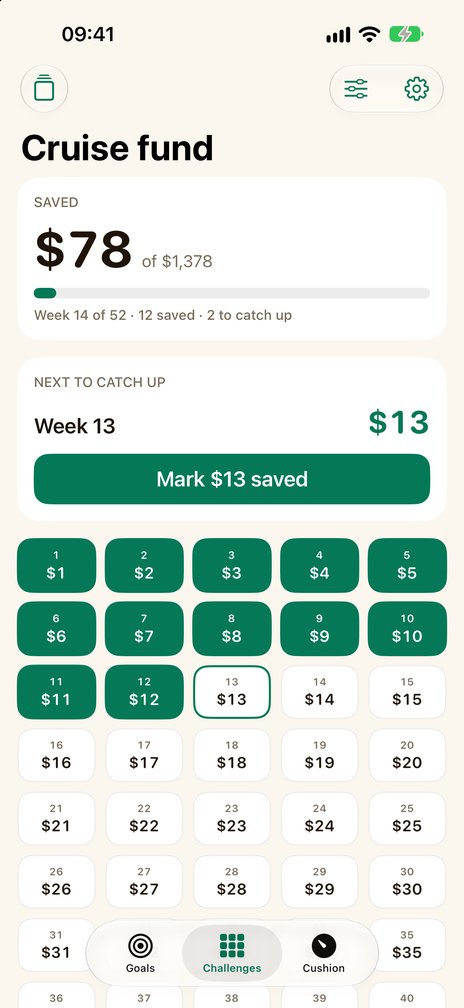
Pennyjar, the iPhone and iPad app these pages belong to, has three tabs: Goals, Challenges and Cushion. The Challenges tab runs the 52-week challenge (a little more each week, largest first or the same every week), the 100-envelope challenge, and custom challenges of 2 to 156 weeks. The monthly, biweekly and penny challenges are not separate challenges in the app: they are the PDFs and calculators on this site, on paper.
Free Pennyjar runs one challenge at a time; Pennyjar Pro, one payment for the whole app, lets several run together and adds custom challenges of 2 to 156 weeks with your own amounts. Pennyjar is a record of what you set aside: it never holds or moves your money, and it is not financial advice.
Coming soon to the App Store
More free savings tools
Last reviewed 8 October 2026