 Pennyjar · for iPhone and iPad
Everything you set aside, in one app
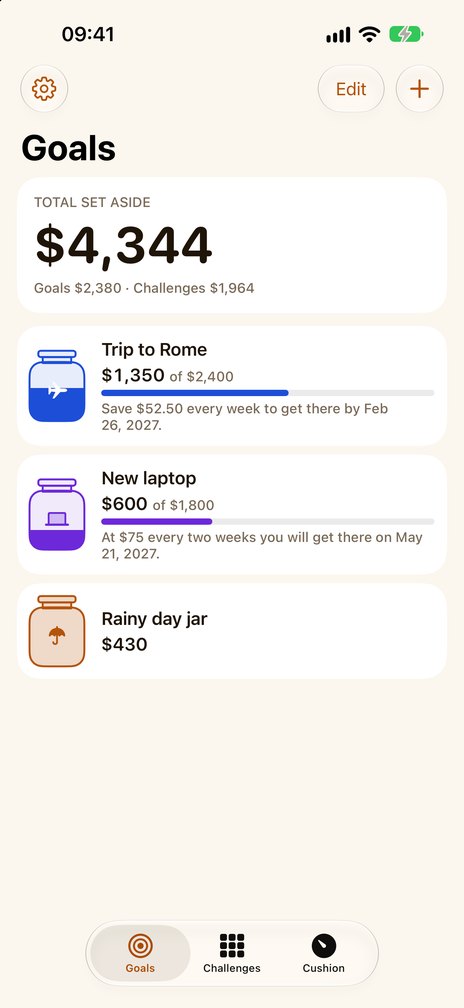
Pennyjar is the record of what you set aside: a jar for every savings goal, the 52 week and 100 envelope challenges, and your emergency fund counted in months. You type in the numbers; Pennyjar does the math and shows how far you are.
Coming soon to the App Store
One app, one purchase: Pennyjar Pro, one payment, no subscription.
One app, three parts
Goals, Challenges and Cushion are three tabs of the same app. It is one record and one purchase. Start with a goal, a challenge or your cushion; the other two are one tab away.
Goals
A jar for every savings goal, with a plan that says how much to put in to get there by a date. How goals work ↓
Challenges
The 52 week and the 100 envelope challenges: tap a week to mark it saved and see how many you have to catch up on. The Challenges part →
Cushion
Your emergency fund in months of spending, one next step at a time, and a debt payoff plan. The Cushion part →
One total
The total set aside adds up what your goals and your challenges hold, on one card.
Cushion to goal
When your next step is to set money aside for your cushion, one tap starts an “Emergency fund” goal with the amount filled in.
A record, not a bank
Pennyjar never holds or moves your money and has no link to a bank. It records what you set aside, wherever you keep it.
Goals: a jar for every savings goal
Try one below. The goals part works the way the jar on this page does.
Try a jar
Move the slider and watch the jar, the amounts and the plan sentence change. The plan is worked out the way the app works it out.$1,344of $2,400 · $1,056 to go
Save $39.12 every week to get there by Apr 5, 2027.
Next deposit: Monday, October 5
What the Goals part keeps
Goals and jars
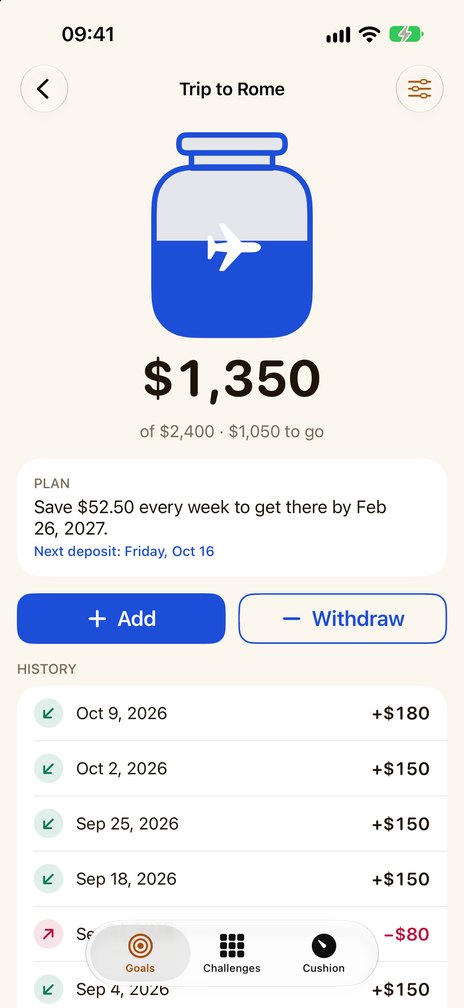
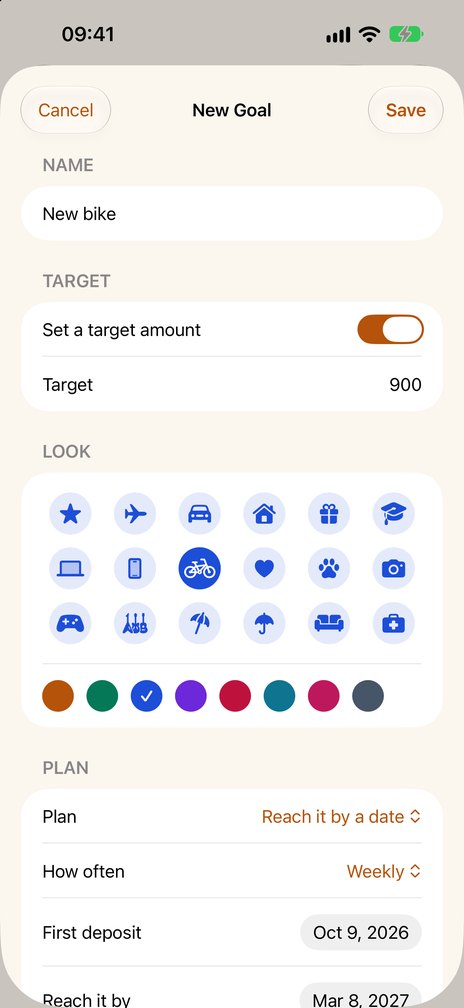
A goal with a target fills up as you save. A jar without a target simply counts what is in it. Each one gets a symbol and a color.
Deposits and withdrawals
Record each one with its date and a note. Correct or delete an entry later.
Never below zero
A jar cannot go below zero: a withdrawal larger than what the jar held on that day is refused.
Your currency
Amounts are shown in your region's currency.
A plan that does the arithmetic
Give a goal a plan and Pennyjar works out the rest. There are two kinds, and these are the sentences the app writes for them.
Reach it by a date
Save $50 every week to get there by Jun 1, 2027.
You say when you need the money; Pennyjar says how much to put in each time. Here, $1,300 over 26 weekly deposits.
Save a set amount
At $75 every two weeks you will get there on Mar 14, 2027.
You say what you can put in; Pennyjar says when you get there. Here, $900 at $75 a time takes 12 deposits.
- Every day, every week, every two weeks or every month. Pick the rhythm that matches when you can put money in.
- Recalculated after each deposit, so a skipped deposit makes the next amounts larger, or the finish date later, instead of leaving a plan that quietly stopped being true.
The same arithmetic is on this site as a free savings goal calculator and a how long to save calculator.
Challenges: 52 weeks and 100 envelopes
- 52 weeks. A little more each week: week 1 is your starting amount and week 52 is 52 times it. Or start with the largest amount, or save the same amount every week.
- 100 envelopes that hold 1 to 100 times your smallest amount, opened in any order.
- Tap a week to mark it saved. See which week you are in and how many you have to catch up on. Started on paper? Say how many are done and they are marked for you.
Free printable charts and a calculator for each are in the Challenges part: the 52-week money challenge and the 100 envelope challenge.
Cushion: emergency fund and debt payoff
- Type in what you have set aside, a typical month (income, needs, wants) and what you owe.
- See how many months of spending your savings would last: under a month, short of your target, or covered. The target is yours, from 1 to 12 months.
- One next step at a time, in a fixed order: first the month in the black, last the cushion you chose. When the step is a debt, it names the one to start with.
- The rules are written out. They are listed on a screen of their own, each with its source or marked as an assumption; the sources are US ones.
Try the arithmetic in the Cushion part: the emergency fund calculator and the snowball vs avalanche comparison.
Reminders
- Goals: a reminder on the deposit days, at the time you choose.
- Challenges: a weekly reminder, on the day and at the time you choose.
- Cushion: a monthly reminder to bring your numbers up to date.
- Reminders are set again each time you open Pennyjar. They are notifications on your device and arrive only if notifications are allowed. The help page has the details.
What it looks like
Free, and what Pro adds
Free
- Two goals or jars and one challenge at a time, with everything above
- In the Cushion: your numbers, the months your savings would last, your next step and what is left free each month
Pennyjar Pro — one payment, no subscription
One purchase unlocks all three parts.
- Goals and jars: as many as you like at the same time
- Challenges: several at the same time, and custom challenges of 2 to 156 weeks with your own amounts
- Cushion: the whole plan, step by step with dates; with two or more debts and money left free each month, avalanche and snowball compared on your own debts; the history of your runway
- CSV export of every goal deposit and withdrawal, and of every challenge deposit
What Pennyjar does not do
- It holds and moves no money. Pennyjar is the record of what you set aside, wherever you keep it. “Withdraw” records that you took money out; it does not take it out for you.
- No bank connection. You type the numbers yourself; nothing is read from an account.
- No interest, no taxes. The plans count no interest on your savings and no taxes.
- No sync between devices. Goals, challenges and numbers are stored on your device.
- No financial advice. A calculation from your numbers, not financial advice. The Cushion's rules cite US sources.
Private by design
No account, no ads. Your goals, challenges and numbers stay on your device; purchases go through the App Store and are verified by RevenueCat — see the privacy policy.
Free calculators and printables
The arithmetic behind the plans, on the web or in a file, with nothing to install.
- Savings goal calculatorhow much to save each week or month to reach a date
- How long will it take to save?at the amount you can put in each time
- Printable savings trackerboxes to color in, or a thermometer
- Sinking fundswhat they are, a list, a calculator and a printable
- Down payment savings calculatorthe down payment on a home, then how much to save
- Savings tracker spreadsheetan Excel, Numbers and Google Sheets template
Calculators and printables for the other two parts
- 52-week money challengeChallenges part: a printable chart for any starting amount
- 100 envelope challengeChallenges part: how it works, the total, a printable tracker
- Money saving challenge printablesChallenges part: every PDF side by side, and which one fits
- Emergency fund calculatorCushion part: how many months of spending your savings cover
- Snowball vs avalancheCushion part: the two ways to pay off debt, side by side
- Which debt first, or save first?Cushion part: the whole ladder for your numbers
Last reviewed 8 October 2026