Savings goal calculator
How much do you have to put aside each week, or each month, to reach a goal by a date? Fill in the target, what you already have, the date and how often you save. You get the amount for each deposit, rounded up to the cent — the way Pennyjar works out a plan.
An example. $3,000 by June 26, 2027, with $600 already saved, comes to $63.16 every week.
How much do I put in each time?
The calculator needs JavaScript. The worked example below shows the same arithmetic.
No interest is counted — here is why that is the cautious figure.
How the amount is worked out
- What is still missing. The target minus what you already have.
- How many deposits. The deposit days from your first deposit to your date, counting both days. The first deposit sets the rhythm: every week is the same weekday each time, every two weeks is every other one, every month is the same day of the month.
- Divide, and round up. What is missing divided by the number of deposits, rounded up to the next cent. Rounding up matters: rounding to the nearest cent can leave you a cent short on the last day, so the total of the deposits can come out a few cents above the target.
- A first deposit date that has passed adds no deposits: only the deposit days from today on are counted, the way the app counts each time it works the plan out again.
The month needs one rule. A monthly plan that starts on the 29th, 30th or 31st falls on the last day of a month that is too short, then returns to its own day the month after. The deposits are always counted from the first one, not from the one before.
| First deposit | Jan | Feb | Mar | Apr | May |
|---|---|---|---|---|---|
| Jan 29, 2027 | 29 | 28 | 29 | 29 | 29 |
| Jan 30, 2027 | 30 | 28 | 30 | 30 | 30 |
| Jan 31, 2027 | 31 | 28 | 31 | 30 | 31 |
| Jan 29, 2028 | 29 | 29 | 29 | 29 | 29 |
| Jan 30, 2028 | 30 | 29 | 30 | 30 | 30 |
| Jan 31, 2028 | 31 | 29 | 31 | 30 | 31 |
No interest — and why that is the cautious figure
The calculator adds no interest. It splits what is missing evenly across the deposits and nothing else. If the money sits in an account that pays interest, you will get there a little sooner than this says, so the figure is the cautious one: it does not lean on money you have not earned yet. It does not count fees or taxes either, or a change in what your goal costs by the time you get there.
A worked example
The same goal at every frequency. The more often you put money in, the smaller each deposit; the total hardly moves.
| Put in | Each time | Deposits | Last one |
|---|---|---|---|
| every day | $9.06 | 265 | Jun 26, 2027 |
| every week | $63.16 | 38 | Jun 21, 2027 |
| every two weeks | $126.32 | 19 | Jun 14, 2027 |
| every month | $266.67 | 9 | Jun 5, 2027 |
Weekly, that is 38 deposits of $63.16, $2,400.08 in all: $0.08 more than the $2,400 that was missing, because each deposit is rounded up to the cent.
How much to save in a year
For a quick figure, divide the target by the number of deposits in a year and round up.
| To save | Every week | Every two weeks | Every month |
|---|---|---|---|
| $1,000 | $19.24 | $38.47 | $83.34 |
| $2,500 | $48.08 | $96.16 | $208.34 |
| $5,000 | $96.16 | $192.31 | $416.67 |
| $10,000 | $192.31 | $384.62 | $833.34 |
| $20,000 | $384.62 | $769.24 | $1,666.67 |
| $50,000 | $961.54 | $1,923.08 | $4,166.67 |
A real calendar can hold one more: a year is 52 weeks and a day, and the first and the last deposit both count. With the first deposit on Monday, October 5, 2026 and the date a year later, saving $10,000 takes 53 weekly deposits of $188.68. The calculator above does that count for your own dates.
The same arithmetic for common goals
Whatever the goal is, the calculator needs three things: the sum, the date and the rhythm. These examples only show the arithmetic; the target is whatever you have chosen.
A vacation
A trip has a date that does not move — use it, or the day the booking has to be paid. For example: $2,400 for a trip on July 1, 2027, with $150 already set aside and a deposit every two weeks from Friday, October 9, 2026, comes to $118.43 each time: 19 deposits, the last on June 18, 2027.
A down payment on a home
Use the day you expect to need the money. This page works out only how to save a sum: it does not size a loan, work out a monthly payment or say how large a down payment should be. For example: $40,000 by March 1, 2029, with $5,000 already saved and a deposit every month from Sunday, November 1, 2026, comes to $1,206.90 each time: 29 deposits, the last on March 1, 2029.
With the cost of a home and a percentage rather than a sum, use the down payment savings calculator: it works out the down payment first, then this plan.
A car
Whether the sum is the full cost or only the down payment, the arithmetic is the same. For example: $12,000 by May 1, 2028, with $2,000 already saved and a deposit every week from Monday, October 12, 2026, comes to $121.96 each time: 82 deposits, the last on May 1, 2028.
A wedding
Use the date the money has to be there: the wedding day, or an earlier date if a payment falls due before it. For example: $18,000 by September 18, 2027, with $3,000 already saved and a deposit every month from Thursday, October 15, 2026, comes to $1,250 each time: 12 deposits, the last on September 15, 2027.
An emergency fund
A reserve has no due date of its own, so give the target you have chosen one. For example: $9,000 by January 1, 2028, with $1,000 already saved and a deposit every two weeks from Friday, October 16, 2026, comes to $250 each time: 32 deposits, the last on December 24, 2027.
This arithmetic in Pennyjar
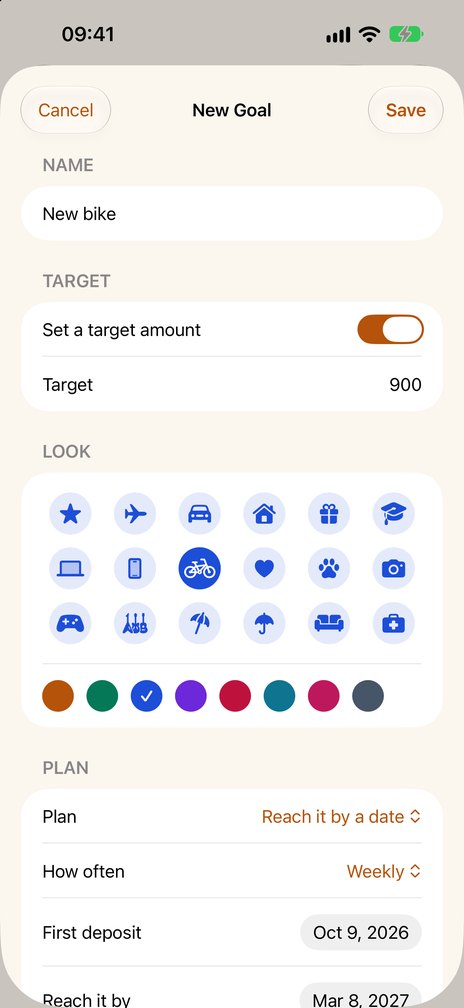
Pennyjar is an iPhone and iPad app that gives every savings goal its own jar on its Goals tab; the 52 week and 100 envelope challenges and an emergency fund counted in months are two tabs beside it. Choose "Reach it by a date", a frequency and the date of the first deposit, and the goal says how much to put in each time — "Save $50 every week to get there by Jun 1, 2027." It starts again from what is still missing after every deposit, and it can send a reminder on each deposit day, at the time you choose.
It is a record: it never holds or moves money and it calculates no interest. Two goals are free; Pennyjar Pro, one payment for the whole app, removes the limit.
Coming soon to the App Store
More from Pennyjar
- How long will it take to save?at the amount you can put in each time
- Printable savings trackerboxes to color in, or a thermometer
- Sinking fundswhat they are, a calculator and a printable
- Down payment savings calculatorthe down payment on a home, then how much to save
- Savings tracker spreadsheetan Excel, Numbers and Google Sheets template
- The Pennyjar appa jar for every savings goal
More free savings tools
Last reviewed 8 October 2026