How much emergency fund should I have?
Two sources say something about it, and neither gives one number for everyone. This calculator does the arithmetic: a month of your spending, times 1, 3 or 6 months or a target you pick, set against what you have saved.
What the sources say. FINRA notes that financial planners often recommend three to six months of living expenses (FINRA, Financial Foundations). The Consumer Financial Protection Bureau says the amount you need depends on your situation (CFPB, guide to building an emergency fund).
The arithmetic. If you spend $3,890 a month, three months of it is $11,670 and six months is $23,340. The calculator does the same with your numbers.
Your month, and your savings
How long it takes — optional
With nothing in the first box, the time is worked out on what is left of your income after spending.
The calculator needs JavaScript on this page. The arithmetic it does is written out below.
Needs: what you have to pay every month — housing, food, transport, insurance — without debt payments. Wants: everything else you spend. Debt payments: the monthly payments on all your debts together. Savings: money you could reach within a few days; retirement accounts and investments stay out. Amounts are in dollars; in another currency the arithmetic is the same. The numbers in the boxes are an example: replace them with yours.
How to calculate 3–6 months of expenses
- Add up a typical month: needs + wants + debt payments. For example $3,890.
- Multiply by the months. Three months: $11,670. Six months: $23,340.
- Take away what you already have. With savings of $3,400, six months still lacks $19,940.
- Divide by what goes in each month, and round up to a whole month. With $910 a month — $4,800 of income less $3,890 of spending — that is 22 months.
That is the whole calculation. It counts no interest on the savings and no change in income or spending along the way.
How much is 3, 6 or 12 months of spending?
Find your monthly spending on the left; the amount is that spending times the months.
| Spending | 3 months | 6 months | 12 months |
|---|---|---|---|
| $1,500 a month | $4,500 | $9,000 | $18,000 |
| $2,000 a month | $6,000 | $12,000 | $24,000 |
| $2,500 a month | $7,500 | $15,000 | $30,000 |
| $3,000 a month | $9,000 | $18,000 | $36,000 |
| $3,500 a month | $10,500 | $21,000 | $42,000 |
| $4,000 a month | $12,000 | $24,000 | $48,000 |
| $5,000 a month | $15,000 | $30,000 | $60,000 |
| $6,000 a month | $18,000 | $36,000 | $72,000 |
| $8,000 a month | $24,000 | $48,000 | $96,000 |
What counts as a month of spending
Pennyjar counts spending as needs plus wants plus the monthly payments on your debts — the same sum as above — and the runway is your savings divided by it. Under one month of spending is red, short of your target is yellow, and the target or more is green. The runway reads rounded down, so a number never claims a month that is not covered yet.
The app's first reserve is narrower: one month of needs and debt payments only, with wants left out. It is the third step of its ladder, and the note under the results shows it for your numbers.
How to calculate monthly expenses
Take a typical month, not the best or the worst one. Needs are what you have to pay; wants are everything else you spend; debt payments are what you actually pay on each debt. Rough figures are fine. FINRA's wording is "living expenses", and Pennyjar applies the months to everything you spend; to count needs only, put zero in Wants and in Debt payments above. A printable monthly expenses worksheet lists the usual expenses in these three groups and adds them up.
Where the 3 and the 6 come from
The scale in Pennyjar has marks at 1 month, 3 months and your target. Three is the low end of the range FINRA mentions and six, the app's starting target, the high end. Because the Consumer Financial Protection Bureau says the amount depends on your situation, the target is yours to set, from 1 to 12 months. "Under one month of spending is the red zone" is a line the app draws itself: an assumption, not a figure from a source.
- FINRA, Financial Foundations (the section "Build an Emergency Fund"). The page shows no date. Checked 2 October 2026.
- Consumer Financial Protection Bureau, An essential guide to building an emergency fund. The page was last updated on 29 October 2025. Checked 2 October 2026.
Your runway in Pennyjar
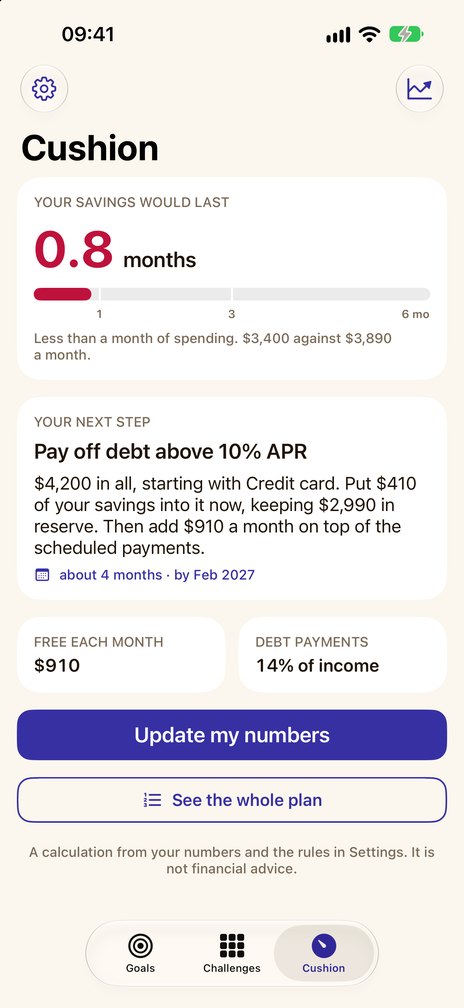
Pennyjar is an iPhone and iPad app with three tabs: Goals, Challenges and Cushion. The Cushion tab turns the same numbers into months of spending your savings would last, and one next step at a time in a fixed order. Free, the Cushion tab gives you your numbers, the months your savings would last, your next step and what is left free each month; the whole plan step by step with dates and the history of your runway are Pro.
Coming soon to the App Store
More calculators
- How long will my savings last?months, and the month the money runs out
- Which debt first, or save first?the whole ladder for your numbers
- Debt payoff calculatorthree ways to pay, month by month
- Snowball vs avalanchemonths and interest for each
- Monthly expenses worksheeta printable PDF that ends in what you spend in a month
A calculation from your numbers and the rules on this page. It is not financial advice, and it says nothing about investing.
More free savings tools
Last reviewed 8 October 2026