Free printable monthly expenses worksheet
A one-page PDF that lists the usual monthly expenses in three groups, and ends in the one number every calculator here starts from: what you spend in a month.
Monthly expenses worksheet (PDF)
Free to download and print: US Letter, one page, no sign-up. It is a sheet to write on, not a fillable form.
How to calculate monthly expenses. Take a typical month and add three totals: your needs, your wants and the monthly payments on your debts. The sum is what you spend in a month. Divide your savings by it and you have your runway in months.
The worksheet
Monthly expenses worksheet
Needs + wants + debt payments = what you spend in a month. Use a typical month; rough figures are fine.
1 Needs
What you have to pay every month: housing, food, transport, insurance. Leave debt payments out; they go in group 3.
- Housing: rent, property tax, repairs
- Utilities, phone, internet
- Food: groceries
- Transport: fuel, fares, parking
- Insurance: health, car, home
Needs, total
2 Wants
Everything else you spend in a month.
- Eating out and takeaway
- Subscriptions and streaming
- Entertainment and hobbies
- Shopping and clothes
- Travel and gifts
Wants, total
3 Debt payments
The monthly payment you actually make on each debt: credit cards, loans, a mortgage.
- Credit card
- Car loan
- Student loan
- Mortgage
- Personal loan
Debt payments, total
+ Yearly and occasional costs
Write the yearly total, divide it by 12, and add the result to a line in group 1 or 2.
| Cost | Per year | ÷ 12 | Goes in |
|---|---|---|---|
| Paid once a year: insurance, a membership | Needs / Wants | ||
| Now and then: car repairs, medical, gifts | Needs / Wants | ||
| Needs / Wants | |||
| Needs / Wants |
Needs +Wants +Debt payments
= What I spend in a month
How many months would my savings cover?
Savings I could reach within a few days (no retirement accounts or investments)
Savings ÷ what I spend in a month = months covered
Round down: to one decimal under ten months, to whole months from ten up.
To aim for months: that many × what I spend in a month =
A calculation from numbers you write down, not financial advice. The same sum done for you: iliafiliaev.com/monthsahead/emergency-fund-calculator/
How to fill it in
- Think of a typical month, not the best or the worst one. Rough figures are fine; your statements show the real ones.
- Group 1, needs: what you have to pay every month — housing, food, transport, insurance. Leave debt payments out; they go in group 3.
- Group 2, wants: everything else you spend in a month.
- Group 3, debt payments: the monthly payment you actually make on each debt — credit cards, loans, a mortgage. A payment goes in one group only, so a mortgage or a loan payment is here and not in needs.
- Yearly and occasional costs: write the year's total, divide it by 12 and add the result to a line in group 1 or 2.
- Add the three totals. The sum is what you spend in a month.
The lines on the sheet are examples to start from, and the blank ones are yours. Whether a cost is a need or a want is your call; the total comes out the same.
A list of monthly expenses, by group
Needs
What you have to pay every month: housing, food, transport, insurance. Rent, utilities, phone and internet, groceries, fuel or fares, insurance premiums, regular medical costs.
Wants
Everything else you spend in a month. Eating out, subscriptions and streaming, entertainment and hobbies, shopping and clothes, travel and gifts.
Debt payments
Credit cards, loans, a mortgage: the monthly payment you actually make on each. The balance is not a monthly expense; the payment is.
Amounts are in dollars; in another currency the arithmetic is the same. Fixed expenses cost the same every month and variable ones change, but the worksheet groups by need, want and debt instead: the total does not depend on how you group.
From monthly expenses to months of savings
The last block of the worksheet divides your savings by the sum. Savings means money you could reach within a few days; retirement accounts and investments stay out. The answer is rounded down — to one decimal under ten months, to whole months from ten up — so it never claims a month that is not covered yet.
| Line | A month |
|---|---|
| Needs | $2,300 |
| Wants | $900 |
| Debt payments a credit card $360 and a car loan $330 | $690 |
| What you spend in a month | $3,890 |
| Savings | $3,400 |
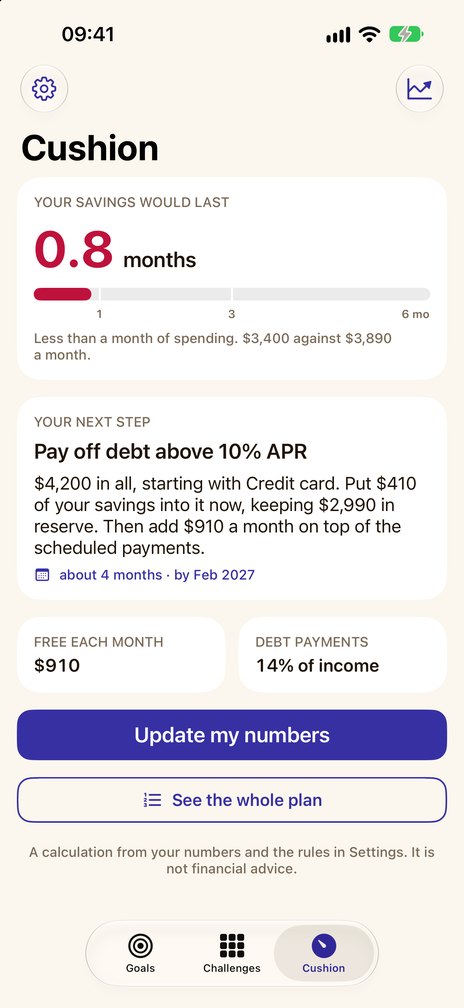
| Savings ÷ what you spend in a month | 0.8 months |
That is a runway of 0.8 months, which the Pennyjar Cushion colors red: under one month of spending. Three months of this spending would be $11,670 and six months $23,340. Two sources say something about how many months to aim for, and the emergency fund calculator sets them out. To see how long your own savings last, and the month they run out, use how long will my savings last.
Questions
What counts as monthly expenses?
Everything you spend in a typical month, in three groups: needs, wants and the monthly payments on your debts. The groups add up to what you spend in a month.
How do I calculate average monthly expenses?
Add up what you spent over several months and divide by the number of months, or fill the worksheet for a typical month. Costs that come once or twice a year are divided by 12 and added in.
Should debt payments be included?
Yes, as their own group: the monthly payment you actually make. Keep them out of needs so that nothing is counted twice.
Is the worksheet free?
The PDF is free to download and print, with no sign-up.
How many months of expenses should I save?
That depends on your situation. The emergency fund calculator shows what 1, 3 and 6 months of your spending come to.
A calculation from numbers you write down, not financial advice.
Your runway in Pennyjar
Pennyjar is an iPhone and iPad app with three tabs: Goals, Challenges and Cushion. On the Cushion tab you type in a typical month (income, needs, wants) and the app shows how many months of spending your savings would last and one next step. The worksheet on this page is a download from this site, not a part of the app.
Coming soon to the App Store
More calculators
A calculation from your numbers and the rules on this page. It is not financial advice, and it says nothing about investing.
More free savings tools
Last reviewed 8 October 2026