Sinking funds: what they are, a list, and a tracker to print
A sinking fund is money you set aside a little at a time for an expense you already know is coming — a car insurance bill, a vet visit, next December's gifts. Instead of one large bill landing in a single month, you spread it over the months before it is due.
In company accounting the same two words mean something else: a fund an issuer builds up to repay its debt. This page is about the household meaning.
How a sinking fund works
- Name the expense and put a figure on it. It can be a known bill or a careful estimate.
- Fix the date it falls due. That is the date the money has to be there.
- Divide. What is needed, divided by the number of deposits between now and the due date, is what to set aside each time. The calculator below does it, rounding up to the cent.
Where the money is kept is a separate question. A sinking fund is the plan and the record of it, not a kind of account.
Common sinking fund categories
These are examples, not a prescription: a fund makes sense for any expense you can name and date, and none of them is needed unless the expense is real for you.
Car
Insurance, registration, servicing, tires, repairs.
Home
Repairs and maintenance, an appliance that will need replacing, furniture, moving costs.
Health
Dental and eye care, prescriptions, the part of a bill your insurance does not cover.
Pets
Vet visits, vaccinations, grooming, boarding.
Gifts and celebrations
Birthdays, holidays, weddings and other occasions that come around every year.
Travel
A trip, flights, a passport renewal.
Yearly bills
Subscriptions and memberships paid once a year, annual fees.
School and children
Fees, uniforms, supplies, camps.
Technology
Replacing a phone or a laptop.
Taxes
Bills that arrive once or twice a year and are known in advance.
Sinking fund calculator
Add each fund with the amount needed and the date it is due. You get what to put in each time for every fund, and the total.
The calculator needs JavaScript. The worked example below shows the same arithmetic.
No interest is counted: why that is the cautious figure.
The tracker to print
Sinking funds
- Put in
- First deposit
| Fund | Needed | Due | Each time | Saved so far | Paid |
|---|---|---|---|---|---|
| Total each time | |||||
Each time = what is still needed, divided by the number of deposit days up to the due date, rounded up to the cent. Mark “Paid” when a bill has been paid.
Pennyjar · iliafiliaev.com/pennyjar
The preview is scaled down. It prints on one page, Letter or A4, with no site around it.
A worked example
Four expenses that are known to be coming, put in every month from October 15, 2026. Each fund is worked out on its own: what is still needed, divided by the deposits up to its due date, rounded up.
| Fund | Each month | Deposits | Due |
|---|---|---|---|
| Holiday gifts$800 needed | $400.00 | 2 | Dec 1, 2026 |
| Car insurance$1,200 needed | $240.00 | 5 | Mar 1, 2027 |
| Vet bills$600 needed, $100 already set aside | $125.00 | 4 | Jan 20, 2027 |
| Yearly subscriptions$240 needed | $30.00 | 8 | Jun 1, 2027 |
| Total each month, while all four run | $795.00 |
While all four are running, $795 goes in on each deposit day. When a fund reaches its due date its deposits stop, so the total drops.
Prefer a spreadsheet? The savings tracker spreadsheet has a Sinking funds sheet that works out the same thing: each fund on its own, and the total.
Sinking funds in Pennyjar
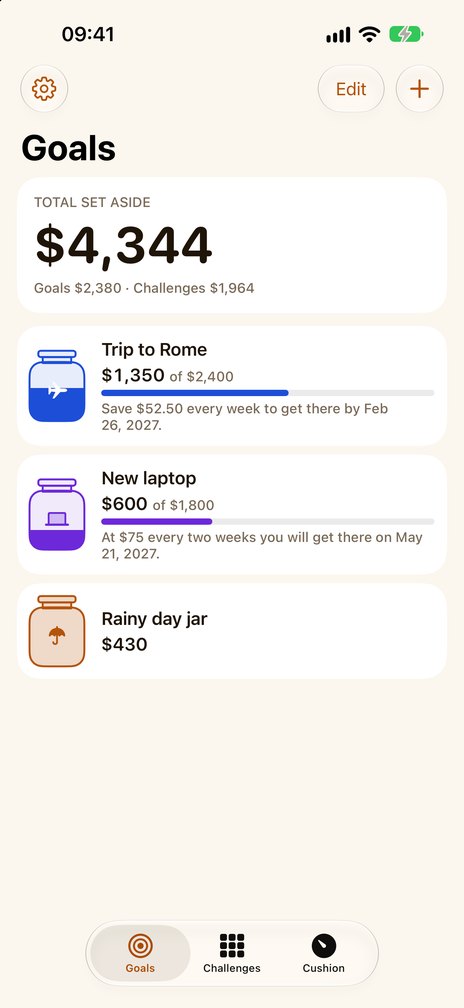
Pennyjar is an iPhone and iPad app that gives every savings goal its own jar on its Goals tab; the 52 week and 100 envelope challenges and an emergency fund counted in months are two tabs beside it. A fund fits it as one goal: name the fund, give it the amount as the target, choose "Reach it by a date" and the due date, and the goal says how much to put in each time — the same arithmetic as the calculator above. It can send a reminder on each deposit day, at the time you choose.
Two goals are free, so two funds can run at the same time; Pennyjar Pro, one payment for the whole app, removes the limit. Pennyjar is a record: it never holds or moves money, so where the money sits is up to you.
Coming soon to the App Store
More from Pennyjar
- Savings goal calculatorhow much to save each week or month to reach a date
- How long will it take to save?at the amount you can put in each time
- Printable savings trackerboxes to color in, or a thermometer
- Savings tracker spreadsheetan Excel, Numbers and Google Sheets template
- The Pennyjar appa jar for every savings goal
More free savings tools
Last reviewed 8 October 2026