Which debt to pay off first — or save first?
Type a typical month, your savings and your debts. The calculator applies the rules of Pennyjar's ladder: it lists your debts in the order the rules work through them, shows where saving sits between them, and names the next step. The rules are written out below, each with its source or the word "assumption".
Under these rules the order is: a month that is in the black; then debt at 36% APR or more, savings included; then one month of needs and debt payments set aside; then debt above 10% APR; then a cushion of three months of spending; then debt that costs more than your savings earn; then your own target. Change the 10%, what your savings earn or the target, and the steps and their amounts change with them.
Your month, your savings, your debts
Your debts
The rules you can change
The calculator needs JavaScript on this page. An example month is worked out below.
Needs: what you have to pay every month — housing, food, transport, insurance — without debt payments. Wants: everything else you spend. Savings: money you could reach within a few days; retirement accounts and investments stay out. Debts: the balance, the APR and the monthly payment you actually make. Switch off "Pay off ahead of schedule" to keep a debt on its schedule. The numbers in the boxes are an example: replace them with yours. Leave a rate empty for its starting value. The 36% line is fixed.
Which debt to pay off first
Under these rules your debts are sorted into classes, and the classes come in a fixed order: first debt at 36% APR or more, then debt above the expensive line (10% to begin with), then debt that costs more than your savings earn. Inside a class the highest rate goes first, and the smaller balance on a tie. A debt that costs no more than your savings earn, or one you switched off, stays on its schedule. The list in the results above is that order for your debts.
Smallest balance first, the snowball order, is the other common way to rank debts. The snowball vs avalanche page runs both on your debts and shows months and interest for each.
Emergency fund or pay off debt first?
The ladder puts saving and debt in one list, so the order between them is part of the rules. The steps, in order:
Get your month into the black
You bring in more than you spend. Until you do, there is no money left over, and no other step gets a date.
Clear debt at 36% APR or more
These come first of all, ahead of any reserve, and your savings go into them too.
Build a one-month reserve
One month of needs and debt payments, set aside before the expensive debts get any of your savings.
Pay off debt above 10% APR
Savings above that one-month reserve go into these debts, together with what is left of the month.
Grow your cushion to 3 months
A cushion of 3 months of everything you spend: needs, wants and debt payments.
Pay off debt that costs more than your savings earn
Debts that cost more than your savings earn (0% to begin with), up to the 10% line. Savings above the cushion of 3 months go into them.
Grow your cushion to 6 months
Your own target, from 1 to 12 months of spending: 6 until you change it. Listed only when the target is above 3 months.
Your foundation is in place
What is left stays on its schedule: debts that cost no more than your savings earn, and any you switched off. "In place" means the steps above are done under these rules; the plan says nothing about retirement accounts or insurance cover, and does not count changes in income.
Four of the order's lines are the app's own assumptions, not figures from a source: debt above the expensive line is paid before the cushion, debt that costs no more than your savings earn stays on its schedule, a one-month reserve comes before any debt except the most expensive, and under one month of spending is red. The three months, and a starting target of six, rest on what FINRA notes about planners' recommendations; the 36% line is the Military Lending Act's cap as the Consumer Financial Protection Bureau describes it, and using it for everyone is again the app's assumption. Each statement is quoted below.
An example month
Take-home income of $4,800, needs of $2,300 and wants of $900, savings of $3,400, a credit card of $4,200 at 24% with a payment of $360 and a car loan of $12,600 at 7.5% with $330. Savings of $3,400 against $3,890 a month is a runway of 0.8 months, which is red. The one-month reserve of needs and debt payments, $2,990, is already covered, so the first step not done is "Pay off debt above 10% APR", starting with the Credit card, and $410 of the savings go into it at once. The ladder for these numbers, as the calculator gives it:
Get your month into the black Done
You bring in more than you spend.
Clear debt at 36% APR or more Done
No debt of this kind.
Build a one-month reserve Done
A month of needs and debt payments is set aside.
Pay off debt above 10% APR Next step
$4,200 in all, starting with Credit card. Put $410 of your savings into it now, keeping $2,990 in reserve. Then add $910 a month on top of the scheduled payments.
about 4 months
Grow your cushion to 3 months Later
Set aside $7,600 more to reach $10,590: 3 months of everything you spend.
about 6 months
Pay off debt that costs more than your savings earn Later
$10,016 in all, starting with Car loan. Then add $1,270 a month on top of the scheduled payments.
about 7 months
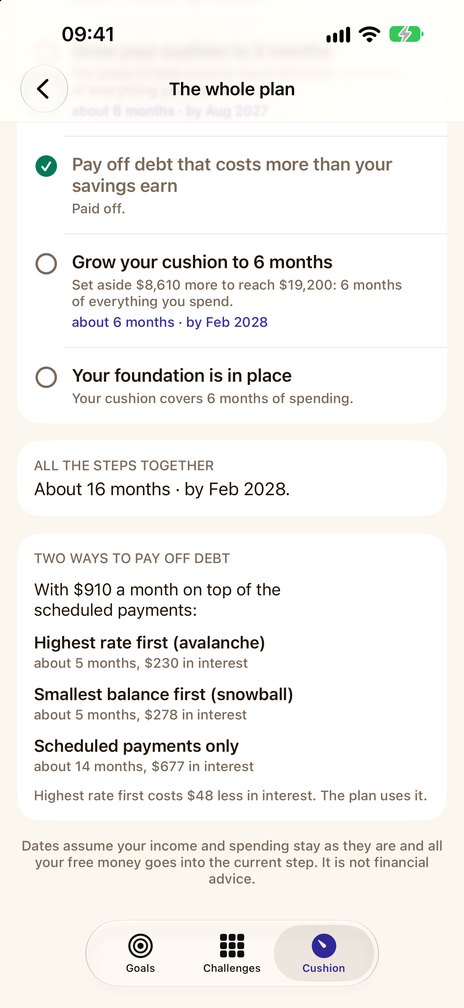
Grow your cushion to 6 months Later
Set aside $8,610 more to reach $19,200: 6 months of everything you spend.
about 6 months
Your foundation is in place Later
Your cushion covers 6 months of spending.
Dates assume income and spending stay as they are and all your free money goes into the current step.
The rules, and where each comes from
These are the eight statements on Pennyjar's screen "Where the numbers come from", word for word. The values in the headings follow the three boxes of rules above, as they follow the three settings in the app.
Debt at 36% APR or more comes first
36% is the most the Military Lending Act lets lenders charge the servicemembers and families it covers, as the Consumer Financial Protection Bureau describes it. The Bureau also notes that a typical two-week payday loan works out to an APR of almost 400 percent. Treating 36% as everyone's line is this app's assumption.
Sourced figure, assumed use
The cushion: 3 months first, then your target of 6
FINRA notes that financial planners often recommend three to six months of living expenses. The Consumer Financial Protection Bureau says the amount you need depends on your situation, which is why the target is yours to set.
Sourced
Debt above 10% APR is paid before the cushion
An assumption of this app. Change the rate in Settings.
Assumption
Debt no dearer than your savings (0%) stays on its schedule
Paying such a debt early would save less than the money earns where it is. The rate is the one set in Settings for what your savings earn. An assumption of this app.
Assumption
A one-month reserve before any debt except the most expensive
An assumption of this app: without any reserve, the next surprise becomes a new debt.
Assumption
Under one month of spending is the red zone
An assumption of this app. The yellow and green zones follow from your own target.
Assumption
A debt not paid off within 50 years counts as never paid off
An assumption of this app: the plan follows every debt month by month for 50 years. One that is still open after that is shown as never paid off, because the payments barely cover the interest or do not cover it at all.
Assumption
What the plan leaves out
Interest on your savings, taxes, changes in income, and anything about investing or retirement accounts. Interest on debt is added once a month at the APR divided by twelve, so a lender's own schedule can differ from this one.
Limits
The pages the statements rest on
- Consumer Financial Protection Bureau, Military Lending Act (MLA). The page was last updated on 8 September 2025. Checked 2 October 2026.
- Consumer Financial Protection Bureau, What is a payday loan?. The page was last reviewed on 28 May 2024; its example is a two-week loan with a fee of $15 per $100 borrowed. Checked 2 October 2026.
- FINRA, Financial Foundations (the section "Build an Emergency Fund"). The page shows no date. Checked 2 October 2026.
- Consumer Financial Protection Bureau, An essential guide to building an emergency fund. The page was last updated on 29 October 2025. Checked 2 October 2026.
The ladder has no step for retirement accounts or an employer's contribution, and the calculator says nothing about investing.
The ladder in Pennyjar
Pennyjar is an iPhone and iPad app with three tabs: Goals, Challenges and Cushion. The Cushion tab runs this ladder on the numbers you type in and shows one next step at a time, in a fixed order. The rules of the plan are listed on a screen of their own, each with its source or marked as an assumption; the sources are US ones. Free, the Cushion tab gives you your numbers, the months your savings would last, your next step and what is left free each month; the whole plan step by step with dates and the history of your runway are Pro.
Coming soon to the App Store
More calculators
- Snowball vs avalanchemonths and interest for each
- Debt payoff calculatorthree ways to pay, month by month
- Emergency fund calculatorwhat 1, 3 and 6 months of spending come to
- How long will my savings last?months, and the month the money runs out
- Printable debt payoff trackera debt list and a payoff log, as PDFs
- Monthly expenses worksheeta printable PDF that ends in what you spend in a month
A calculation from your numbers and the rules on this page. It is not financial advice, and it says nothing about investing.
More free savings tools
Last reviewed 8 October 2026