How long will it take to save?
Enter the target, what you already have, how much you can put in each time and how often. You get the number of deposits and the day you reach the goal — the arithmetic Pennyjar uses when a plan says what date a set amount gets you to.
An example. $6,000 with $1,000 already saved, at $100 every week, takes 50 deposits: you get there on September 13, 2027.
When will I get there?
The calculator needs JavaScript. The tables below show the same arithmetic.
No interest is counted — here is why that is the cautious figure.
How the date is worked out
- What is still missing. The target minus what you already have.
- How many deposits. What is missing divided by the amount you put in each time, rounded up. The last deposit can be smaller: it only has to cover what is still missing.
- The day. The deposit day with that number, counted from your first deposit. If your first deposit date has already passed, the count starts from today, on the same rhythm.
- About how long. One period for each deposit: 100 weekly deposits are 100 weeks. A year is counted as 52 weeks and a month as a twelfth of that, so the answer does not move with the start date. The date itself is exact.
Pennyjar gives no date for a plan that would need more than 36,500 deposits, and neither does this calculator: the day would be a century or more away.
Weekly savings: how long to reach each target
Weekly deposits, nothing added for interest. Find the target in the left column and the amount you put in across the top.
| To save | $25a week | $50a week | $100a week | $250a week | $500a week |
|---|---|---|---|---|---|
| $1,000 | 40 wk | 20 wk | 10 wk | 4 wk | 2 wk |
| $5,000 | 3y 10m | 1y 11m | 50 wk | 20 wk | 10 wk |
| $10,000 | 7y 8m | 3y 10m | 1y 11m | 40 wk | 20 wk |
| $20,000 | 15y 5m | 7y 8m | 3y 10m | 1y 6m | 40 wk |
| $50,000 | 38y 6m | 19y 3m | 9y 7m | 3y 10m | 1y 11m |
| $100,000 | 76y 11m | 38y 6m | 19y 3m | 7y 8m | 3y 10m |
Pick the row and the column and read the time: for example, $10,000 at $100 a week is 100 weeks, about 1 year 11 months. The calculator above gives the exact date for any other amount.
The same amount at a different rhythm
The amount you can put in each time decides how long it takes, and so does how often you do it: the same amount, put in more often, gets you there sooner.
| Put in | Deposits | About | Reached on |
|---|---|---|---|
| every day | 50 | 50 days | Nov 23, 2026 |
| every week | 50 | 50 weeks | Sep 13, 2027 |
| every two weeks | 50 | 1 year 11 months | Aug 21, 2028 |
| every month | 50 | 4 years 2 months | Nov 5, 2030 |
Longer goals
Monthly deposits: $20,000 at $500 every month from Sunday, November 1, 2026 takes 40 deposits, about 3 years 4 months: the last one is on February 1, 2030.
A very large goal is the same sum: $1,000,000 at $500 every week is 2,000 deposits, about 38 years 6 months, until January 26, 2065. No interest is counted; interest on the savings would shorten it.
This arithmetic in Pennyjar
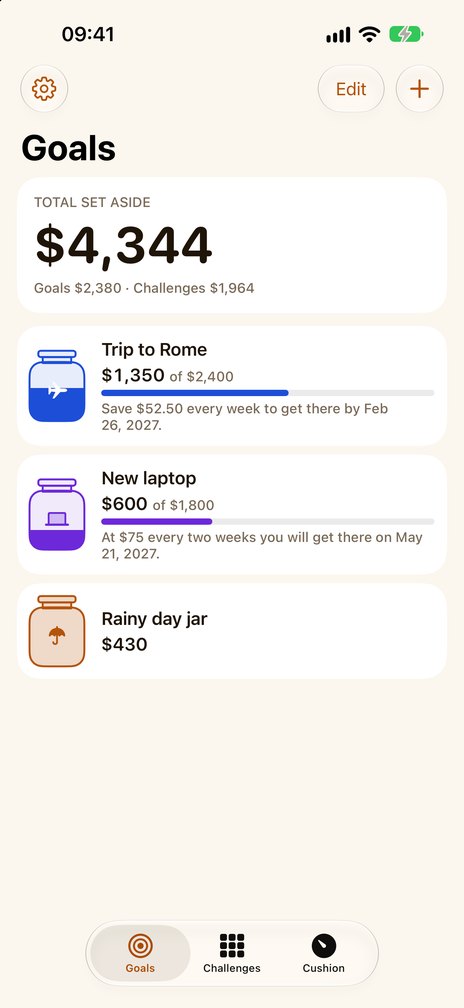
Pennyjar is an iPhone and iPad app that gives every savings goal its own jar on its Goals tab; the 52 week and 100 envelope challenges and an emergency fund counted in months are two tabs beside it. Choose "Save a set amount", a frequency and the date of the first deposit, and the goal says when you will get there — "At $75 every two weeks you will get there on Mar 14, 2027." The date moves later if you skip a deposit, because the plan starts again from what is still missing.
It is a record: it never holds or moves money and it calculates no interest. Two goals are free; Pennyjar Pro, one payment for the whole app, removes the limit.
Coming soon to the App Store
More from Pennyjar
- Savings goal calculatorhow much to save each week or month to reach a date
- Printable savings trackerboxes to color in, or a thermometer
- Sinking fundswhat they are, a calculator and a printable
- Down payment savings calculatorthe down payment on a home, then how much to save
- Savings tracker spreadsheetan Excel, Numbers and Google Sheets template
- The Pennyjar appa jar for every savings goal
More free savings tools
Last reviewed 8 October 2026